🇫🇷 France
Paris
The City of Light
Best Time
Apr – Jun
Avg. Budget
€80–€200/day
Ideal Stay
4–7 days
Rating
★ 4.8 (5.1k)
🇫🇷 France
The City of Light
Best Time
Apr – Jun
Avg. Budget
€80–€200/day
Ideal Stay
4–7 days
Rating
★ 4.8 (5.1k)
Overview
Paris has been inspiring artists, writers, philosophers, and lovers for over two millennia. The City of Light earned its nickname during the Enlightenment, when it became the intellectual capital of the world, and later when it was one of Europe's first cities to adopt gas street lighting. Today it remains luminous in every sense — culturally, architecturally, gastronomically, and romantically.
The city is organised into 20 arrondissements (districts), each with its own character. The Marais preserves medieval streets and vibrant Jewish and LGBTQ+ communities. Saint-Germain-des-Prés is the heartland of French intellectual café culture. Montmartre's winding lanes still carry the bohemian spirit of Picasso and Toulouse-Lautrec. And the grand Haussmann boulevards link it all with geometric precision.
Beyond the iconic landmarks, Paris rewards slow exploration. Picnic along the Seine with a baguette and cheese, browse the bouquinistes (riverside booksellers), linger over a café crème watching the world walk by. The city is best experienced at a stroll, not a sprint.
Must See
From iron towers to Impressionist masterpieces, Paris delivers wonder at every corner.
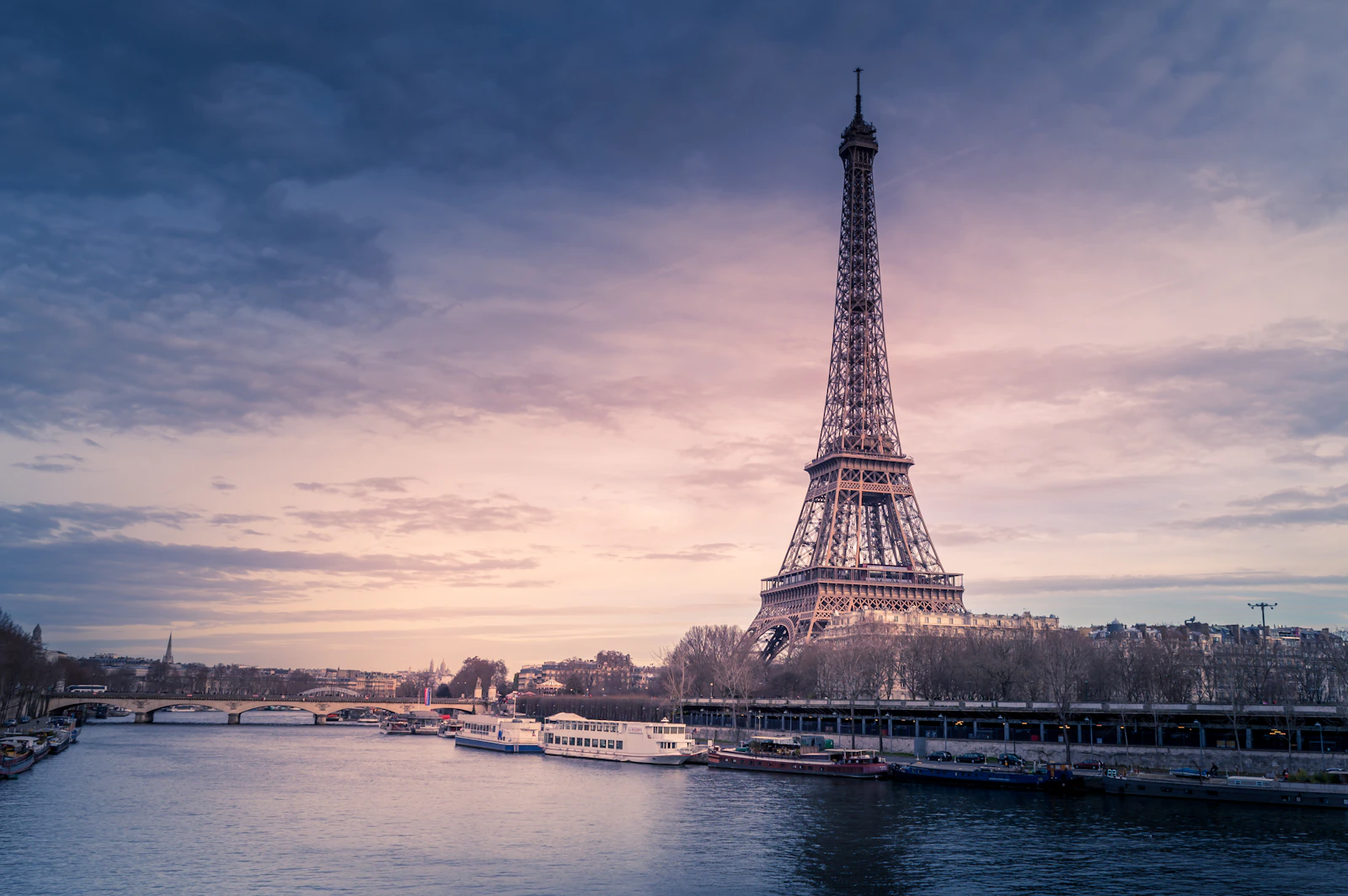
Gustave Eiffel's 330-metre iron lattice tower was built as a temporary exhibition piece for 1889's World Fair and was nearly demolished. Today it's the world's most visited paid monument. Take the lift to the top level at night for the sparkling light show and panoramic views of the Seine.
The world's largest art museum and a historic monument houses over 35,000 works in a former royal palace. From the Mona Lisa and Venus de Milo to ancient Egyptian antiquities — even a week wouldn't cover everything. Book tickets in advance to skip the queue.
Perched on Paris's highest hill, this bohemian village neighbourhood was once home to Picasso, Modigliani, and Toulouse-Lautrec. The gleaming white Sacré-Cœur basilica crowns the summit with panoramic city views. Wander the lanes, visit Place du Tertre's portrait artists, and catch a cabaret at the Moulin Rouge below.
Plan Your Trip
Paris is beautiful year-round but each season offers a very different atmosphere.
Cherry blossoms, café terraces open, Jardins de Luxembourg in bloom. Moderate crowds and comfortable temperatures make this Paris's finest season.
Paris Plages transforms the Seine banks into urban beaches. Long evenings are magical. Crowds are heavy and hotels expensive — book months ahead.
Golden leaves in the parks, the fashion world descends for Fashion Week, and the Vendange (wine harvest) celebrations begin. September is outstanding.
Christmas markets, ice rinks, and the city draped in lights. Fewer tourists, lower prices, and the museums are nearly empty. Cold but magical.
Practical Info
Everything you need to know before you book your Paris adventure.
EU/EEA citizens need only a national ID. Most other countries require a Schengen Visa (90 days within any 180-day period). USA, Canada, Australia, and UK citizens can enter without a visa for up to 90 days.
Charles de Gaulle (CDG) is Paris's main international hub, 25 km northeast of the centre. RER B train takes 35 minutes to Gare du Nord. Orly (ORY) serves southern Europe and domestic routes.
Paris's Métro is one of the world's densest and most efficient. A carnet of 10 tickets or a Navigo pass covers metro, bus, RER, and tram. Vélib' bike-share is perfect for the Marais and Canal Saint-Martin.
Budget hostels from €25/night, boutique hotels €100–200, luxury palaces €500+. Stay in Le Marais (central, vibrant), Saint-Germain (elegant), or Montmartre (atmospheric and slightly cheaper).
A baguette costs €1, a café crème €2–4, a bistro lunch formule €14–18. Must-tries: croque-monsieur, steak frites, crème brûlée, and macarons from Ladurée. Paris has more Michelin-starred restaurants than any city on Earth.
Paris is generally safe. Beware pickpockets around the Eiffel Tower, Louvre, and Métro. Keep bags in front, avoid loud distractions. Tap water is safe to drink. Emergency: dial 15 (SAMU) or 112.
Visual Tour
A glimpse of Paris's timeless beauty and effortless style.
History
Paris's origins stretch back over two millennia to a small Celtic tribe, the Parisii, who settled on the Île de la Cité in the Seine River around 250 BC. Roman legions under Julius Caesar conquered the settlement in 52 BC, renaming it Lutetia Parisiorum. The Romans built baths, an amphitheatre, and a forum on the Left Bank — ruins of which survive beneath today's Latin Quarter. After Rome's fall, the Frankish king Clovis I made Paris his capital in 508 AD, and the city began its long journey to becoming the centre of French civilisation. The construction of Notre-Dame Cathedral in 1163 announced Paris's medieval ambitions to the world.
The French Revolution of 1789–99 transformed Paris and the world. The storming of the Bastille fortress on 14 July 1789 triggered the overthrow of the monarchy and the declaration of the Rights of Man. The revolutionary and Napoleonic periods reshaped Paris physically — the Louvre became a public museum in 1793, and Napoleon's Grande Armée marched under his newly commissioned Arc de Triomphe. Later, Baron Haussmann's massive urban renewal of 1853–70 demolished medieval slums and created the grand boulevards, uniform stone facades, and park system that define Paris's appearance today, though critics argued it also destroyed much authentic character.
The 20th century brought Paris both triumph and tragedy. The Belle Époque produced the Eiffel Tower, Impressionism, and an extraordinary flourishing of art, literature, and café culture. The Nazi occupation of 1940–44 was a dark chapter — though Paris was largely spared physical destruction, the roundup and deportation of Paris's Jewish community to Nazi death camps remains a profound historical wound. Liberation came on 25 August 1944, when Free French forces under General Leclerc entered the city to scenes of euphoric celebration.
Contemporary Paris remains one of the world's most culturally productive cities. The Centre Pompidou opened in 1977, the Louvre Pyramid in 1989, and the Musée du Quai Branly in 2006 — each new cultural institution sparking fierce debate before becoming beloved landmarks. Fashion, gastronomy, philosophy, film, and fine art continue to flow from Paris in extraordinary abundance. Today, the city's rapidly evolving neighbourhoods — the tech buzz of Station F in the 13th, the multicultural energy of Belleville, the gentrification of South Pigalle — show a city perpetually reinventing itself while fiercely protecting its identity.
Paris has more Michelin-starred restaurants than any other city on Earth. It also has the world's most visited museum (the Louvre, with 9 million annual visitors), the world's most visited paid monument (the Eiffel Tower), and the world's most visited cemetery (Père Lachaise, where Jim Morrison, Oscar Wilde, Édith Piaf, and Frédéric Chopin are buried).
On 25 August 1944, General Charles de Gaulle walked down the Champs-Élysées through enormous crowds as Paris was liberated from four years of Nazi occupation. His historic speech at the Hôtel de Ville that evening declared that Paris was "liberated by itself, liberated by its people with the help of the armies of France." It remains one of the most celebrated moments in European history.
Where to Stay
Paris's 20 arrondissements each have distinct characters — choosing your base shapes everything from morning croissant stops to evening walks along the Seine.
Paris's best-preserved medieval quarter and the most vibrant neighbourhood for first-time visitors. Home to the Place des Vosges (Paris's oldest planned square), the Musée Picasso, Jewish heritage around Rue des Rosiers, and the LGBTQ+ heart of the city. Narrow cobblestone streets lined with galleries, vintage boutiques, and outstanding falafel restaurants make it one of the world's great walking neighbourhoods. Book accommodation here for central access to the Louvre and Notre-Dame.
Perched on Paris's highest hill, Montmartre retains the atmosphere of the bohemian village where Picasso, Modigliani, and Toulouse-Lautrec lived and worked. The gleaming white Sacré-Cœur basilica crowns the summit. Wander the winding cobblestone streets, visit Place du Tertre's portrait artists, and watch the lights of Paris spread out below at night. Slightly further from major museums but significantly more atmospheric and affordable than central Paris.
The intellectual heart of Paris — where Sartre, de Beauvoir, and Camus held court at Café de Flore and Les Deux Magots. Today Saint-Germain remains Paris's most elegant neighbourhood, with its designer boutiques on Boulevard Saint-Germain, the Jardins du Luxembourg, and the highest concentration of antiquarian bookshops in the city. An excellent base for the Musée d'Orsay, Luxembourg Gardens, and Left Bank café culture. Prices reflect the prestige.
The 11th arrondissement around Bastille and Oberkampf is Paris's liveliest neighbourhood after dark — packed with bars, live music venues, and excellent restaurants at prices that haven't yet been inflated by tourism. Rue Oberkampf and Rue de la Roquette are the main arteries. The Marché d'Aligre provides a fantastic local market experience on weekend mornings. An ideal base for travellers who want authentic Parisian neighbourhood life rather than a tourist bubble.
The trendy Canal Saint-Martin neighbourhood has replaced Montmartre as Paris's creative hub — lined with independent boutiques, coffee shops, record stores, and excellent natural wine bars. The canal itself, with its iron footbridges and tree-lined banks, is a favourite spot for picnics on warm evenings. The Hotel du Nord (immortalised in Marcel Carné's 1938 film) still stands on the canal. More authentic than the tourist trail and significantly more affordable.
Paris's most exclusive residential arrondissement, home to embassies, old-money Parisian families, and the Trocadéro — which offers the finest unobstructed view of the Eiffel Tower from across the Seine. The Palais de Chaillot, Musée Marmottan Monet, and Roland Garros tennis stadium are nearby. Quieter than central Paris and the preserve of the affluent, but the location opposite the Eiffel Tower makes it worth considering for a special occasion stay.
Hidden Gems
Beyond the Eiffel Tower and the Louvre, Paris rewards exploration with extraordinary museums, gardens, and architectural masterpieces at every turn.
Housed in a magnificent Beaux-Arts railway station on the Seine's Left Bank, the Musée d'Orsay holds the world's greatest collection of Impressionist and Post-Impressionist masterpieces. Monet's Water Lilies series, Van Gogh's self-portraits, Renoir's Moulin de la Galette, Degas's ballet dancers, and Seurat's pointillist canvases fill gallery after gallery in a building that is itself a work of art. The giant clock windows overlooking the Seine provide one of Paris's great interior views. Booking tickets in advance is essential — queues at the door can exceed two hours in summer.
The heartbeat of Paris for 850 years, Notre-Dame Cathedral suffered devastating fire damage in April 2019 but reopened in December 2024 following one of history's great restoration efforts. The rebuilt spire and restored interior are even more magnificent than before, combining medieval Gothic grandeur with 21st-century craftsmanship. Standing on the Île de la Cité at the geographical heart of Paris, with kilometre zero marked in the cobblestones outside, Notre-Dame is the symbolic centre of France itself and an unmissable visit after its triumphant return.
Hidden within the Palais de Justice complex on the Île de la Cité, Sainte-Chapelle is Paris's most awe-inspiring interior — a royal chapel built by Louis IX in just 7 years (1242–1248) to house his collection of sacred relics. The upper chapel is enclosed almost entirely in 15 panels of Gothic stained glass, 1,113 biblical scenes covering over 600 square metres, creating an extraordinary kaleidoscope of coloured light when the sun shines through. One of the greatest achievements of French Gothic architecture and far less crowded than Notre-Dame.
Eat & Drink
Parisian cuisine is simultaneously the world's most influential food culture and its most democratic — a country where the perfect baguette costs €1.30 and a three-course lunch formule at a neighbourhood bistro costs €16. France invented the restaurant, the chef as celebrity, and the concept of fine dining. But the soul of Paris lives in its boulangeries, fromageries, charcuteries, and the neighbourhood bistros where locals gather every day. UNESCO has recognised French gastronomic culture as an Intangible Cultural Heritage of Humanity.
The perfect Parisian croissant should be all-butter (au beurre), deeply caramelised on the outside, with hundreds of flaky laminated layers and a slightly chewy interior. Seek out award-winning boulangers like Du Pain et des Idées or Maison Landemaine. A fresh pain au chocolat, kouign-amann, or chausson aux pommes alongside a café crème is the definitive Parisian breakfast — eat it standing at the zinc bar for the full experience.
France's unofficial national dish — a simply grilled entrecôte or bavette steak cooked to a pink blush, served with a mountain of crisp hand-cut frites and either béarnaise or maître d'hôtel butter. Ordered "saignant" (rare) by Parisians who know. The best versions are served at classic bistros like Le Relais de l'Entrecôte (which serves nothing else) or Le Comptoir. The thin-cut "pommes allumettes" frites alongside are the gold standard for French fries worldwide.
The iconic soupe à l'oignon gratinée — caramelised onion broth topped with crusty bread and a thick melted Gruyère crust — originated in Paris as a restorative dish for market workers at Les Halles. It's now served across every classic bistro in the city, typically as a winter starter. The best version requires hours of slow-cooking the onions to concentrated sweetness. Au Pied de Cochon near the former market site serves it around the clock, 24 hours a day.
Land snails baked in individual ceramic moulds or shells with garlicky, herbed butter — one of France's great bistro classics and a quintessential Parisian dining experience. The butter sauce, made with parsley, garlic, and shallots, is so good that Parisians mop it up with chunks of baguette. Ignore any squeamishness — escargots are delicate in flavour and the real story is the extraordinary compound butter surrounding them. Order them at any traditional brasserie.
Sweet crêpes are a street food staple across Paris, filled with butter and sugar, Nutella, or salted caramel. But the superior form is the buckwheat galette — a savoury Breton pancake served in creperies around Montparnasse station, filled with ham, eggs, cheese, or mushrooms and folded into a perfect square. Pair with a bowl of Breton cider for the complete experience. The Montparnasse neighbourhood has dozens of Breton creperies serving authentic versions.
French pâtisserie is an art form practised with almost obsessive precision. The Paris macaron — two almond meringue shells sandwiching a flavoured ganache — was perfected by Ladurée in the 1930s and is now available in 36 flavours. But the true pinnacle is the pastry counter of any quality Paris pâtisserie: tarte tatin, Paris-Brest, mille-feuille, and éclair au chocolat that look like jewellery and taste like concentrated happiness. Pierre Hermé, Cyril Lignac, and Cédric Grolet are the current masters.
Shop
From the world's grandest department stores and flagship luxury boutiques to flea markets and independent bookshops, Paris offers an unmatched range of retail experiences.
The magnificent Belle Époque department store on Boulevard Haussmann is more than a shop — the main building's art nouveau stained-glass dome is a Paris landmark in its own right. Nine floors of luxury fashion, cosmetics, food hall (Gourmet Ground Floor), and homeware. The rooftop terrace offers a free panoramic view of the Opéra Garnier and Haussmann rooftops. Excellent for last-minute luxury gifts and accessible French fashion brands.
The streets around Rue de la Verrerie and Rue des Archives in the Marais are packed with excellent vintage clothing stores — Kiliwatch, Free'P'Star, and Vintage Désir among the best. French vintage fashion is world-class quality and surprisingly affordable. The Marais also houses the flagship stores of A.P.C., Jacquemus, Maison Kitsuné, and other quintessentially Parisian brands that define global fashion trends from their home neighbourhood.
The world's largest antiques market, at the northern edge of Paris in Saint-Ouen, covers 7 hectares and contains over 2,000 dealers selling everything from 18th-century furniture to Art Deco jewellery, vintage posters, and mid-century design. Open Saturday, Sunday, and Monday. The serpentine alleyways of the Marché Vernaison section are the most atmospheric. Arrive early, wear comfortable shoes, and be prepared to negotiate. Shipping services are available for large purchases.
The legendary Shakespeare and Company English bookshop on the Left Bank — beloved of Hemingway, Fitzgerald, and generations of literary travellers — remains one of the world's great independent bookstores. The 900 green boxes of the bouquinistes (second-hand book sellers) lining both banks of the Seine have operated continuously since the 16th century, selling old books, prints, vintage postcards, and maps. Browsing them for an afternoon is one of Paris's great free pleasures.
Beyond the City
Within two hours of Paris by train lie royal palaces, Impressionist gardens, medieval cathedrals, and the vineyards that produce the world's most celebrated wines.
The Palace of Versailles — the greatest royal palace in the world — was the seat of French power from 1682 until the Revolution. Louis XIV's Hall of Mirrors, the royal apartments, Marie Antoinette's Hamlet, and 800 hectares of formal gardens designed by André Le Nôtre are among Europe's supreme cultural achievements. Buy the combined passport (includes gardens, Grand Trianon, and Petit Trianon). Arrive at opening time to beat the crowds that gather from 10am onwards in summer.
Claude Monet's house and garden at Giverny in Normandy — where he lived from 1883 until his death in 1926 — is one of the world's most beautiful gardens and the direct inspiration for his celebrated Water Lilies series. The Japanese bridge, weeping willows, and lily pond look exactly as in the paintings. The house interior, preserved in vivid colours with Monet's Japanese print collection, is equally captivating. Visit in May–June for the peak flower season.
The cathedral city of Reims is the historic coronation site of French kings and the gateway to the Champagne region's grande maison cellars — Taittinger, Veuve Clicquot, and Ruinart offer extraordinary guided tours through kilometres of chalk caves where millions of bottles age quietly. The Reims Cathedral itself, where 26 kings were crowned over 800 years, is one of France's finest Gothic monuments. A half-day Champagne tasting tour combined with cathedral visit makes for a perfect day from Paris.
The Loire Valley — UNESCO World Heritage listed — contains the greatest concentration of Renaissance châteaux in the world. Chenonceau (spanning the Cher River on six arches), Chambord (François I's hunting lodge with 440 rooms and a double-helix staircase attributed to Leonardo da Vinci), and Amboise (where Leonardo spent his final years) are the highlights. Tours or Blois make good bases. Wine tasting at Vouvray and Sancerre vineyards adds to the indulgence.
Trip Planning
Paris rewards both whirlwind visits and slow, extended stays. These itineraries balance the unmissable with the genuinely Parisian, avoiding tourist traps in favour of real experiences.
The Essential Highlights
Eiffel & Left Bank
Morning: Eiffel Tower summit (book in advance). Afternoon: Musée d'Orsay. Evening: Seine walk, dinner in Saint-Germain.
Louvre & Marais
Morning: Louvre Museum (book! 2–3 hours minimum). Afternoon: wander Le Marais lanes, falafel at Rue des Rosiers, Place des Vosges.
Montmartre & Versailles
Morning: Versailles day trip (RER C, 40 min). Evening: return for Montmartre sunset and dinner in a bistro on Rue Lepic.
The In-Depth Experience
Arrival & Right Bank
Stroll the Champs-Élysées, Arc de Triomphe rooftop, dinner in the 8th arrondissement.
Eiffel & Musée d'Orsay
Eiffel Tower morning, Trocadéro view, Musée d'Orsay Impressionists, evening bistro in Saint-Germain.
Versailles Day Trip
Full day at the Palace and Gardens of Versailles, returning for evening at Canal Saint-Martin bars.
Louvre & Le Marais
Louvre morning (Mona Lisa, Venus de Milo), afternoon in Marais galleries and coffee shops, evening at Pompidou.
Montmartre & Puces
Morning: Sacré-Cœur and Montmartre lanes. Afternoon: Saint-Ouen flea market. Farewell dinner at a classic brasserie.
The Full Discovery
Arrival & Latin Quarter
Settle in, explore the Latin Quarter, browse Shakespeare & Company, dinner on Île Saint-Louis.
Grand Museums
Louvre morning, Sainte-Chapelle afternoon, Seine sunset walk, Montparnasse galette dinner.
Impressionists Day
Musée d'Orsay all morning, Rodin Museum garden, picnic at Luxembourg Gardens.
Versailles
Full day at Versailles palace and its extraordinary formal gardens; Grand and Petit Trianon included.
Giverny
Monet's house and garden at Giverny in full bloom (best May–June), Seine valley countryside.
Marais & Bastille
Marais galleries and flea market, evening wine bar crawl in the 11th arrondissement.
Eiffel Farewell
Morning market at Rue Mouffetard, Eiffel Tower picnic, evening light show — the perfect farewell to Paris.
Local Knowledge
Parisians have a reputation for being unfriendly to tourists — a reputation that largely dissolves the moment you make even a small effort to meet them halfway with basic French courtesies.
The single most effective thing any visitor can do is open every interaction with "Bonjour, Madame/Monsieur" and close it with "Merci, au revoir." Walking into a café and immediately speaking English in a loud voice is genuinely considered rude. A smile and "Excusez-moi, parlez-vous anglais?" goes a very long way. Even broken French earns enormous goodwill from Parisians who take pride in their language and culture.
In Paris, a café table is rented by the hour — nobody will rush you out after finishing a coffee. However, prices at table service (en salle) are typically 30–50% higher than standing at the bar (au comptoir). Order "un café" and you'll receive a short espresso. Café allongé is a longer espresso; café crème is espresso with steamed milk. Never ask for a cappuccino in a traditional café — it marks you as a tourist immediately.
Parisians eat lunch from 12:30–2:00pm and dinner from 7:30–9:30pm. Arriving at a restaurant at 6pm will be met with confusion. The formule (set menu) at lunch — typically starter + main or main + dessert for €15–20 — is the best value in Paris. Bread is always included and free. Tap water (une carafe d'eau) is free on request — you're not obliged to order bottled water. Service charge (service compris) is included in all bills by law.
Tipping is not expected in France — service charge is legally included in all restaurant bills. However, rounding up or leaving €1–2 for genuinely excellent service is appreciated. Most Paris restaurants and shops accept credit cards, but some boulangeries and smaller market stalls are still cash only — carry small notes. Contactless payment is universal in larger establishments. Sunday is a shopping day in tourist areas but many local shops close.
Stand to the right on escalators, walk on the left. Give up seats marked for elderly, pregnant, and disabled passengers — this is taken seriously in Paris. Keep phone conversations brief and voice low — Parisians are very quiet on public transport. Validate your ticket before the platform — inspectors are active. Keep your bag in front of you on busy lines (especially line 1 and line 4) to deter pickpockets.
Parisians dress with understated elegance even for casual occasions — the tracksuit-and-loud-tourist look is immediately noticeable. For restaurants above bistro level, smart casual is appropriate. Church visits require covered shoulders and knees. The classic Parisian look favours neutral colours, quality over logos, and the appearance of effortless chic (what the French call "je ne sais quoi"). A simple well-fitted outfit in neutral tones is the most powerful travel wardrobe choice in Paris.
Your Journey Awaits
La vie est belle — start planning your Paris adventure today.